

Celebrating 35 Years of the Defense Commissary Agency
Social Media Version: As DeCA celebrates its 35th birthday Oct. 1, 2026, it is a good time to look back at how commissaries began and how far they have come. Read the full story on our website. Download the full story and graphic on DVIDS.
FORT LEE, Va. — The Defense Commissary Agency (DeCA) was established May 15, 1990. Maj. Gen. John P. Dreska became its first director, and the transition team adopted the slogan, “Quality First, People Always.”
DeCA assumed full control of military commissaries worldwide Oct. 1, 1991. The agency united four separate service systems into one organization focused on delivering a consistent, affordable grocery benefit to military communities.
As DeCA celebrates its 35th birthday Oct. 1, 2026, it is a good time to look back at how commissaries began and how far they have come.
“For 35 years, DeCA has carried forward a benefit built on a simple promise: Provide service members and their families with quality groceries and meaningful savings,” said Bill Fitzhugh, DeCA director and CEO. “As we celebrate this anniversary, we remain focused on modernizing the shopping experience while preserving the value, trust and service our military communities expect from their commissaries.”
Commissaries date back to 1775, when the Continental Congress established the Office of Commissary General of Stores and Purchases to provide daily rations to the Continental Army. By 1825, Army officers at certain posts could buy goods at cost for personal use. In 1841, that privilege was extended to their immediate families.
During the Civil War, commissary departments purchased, transported and distributed food and supplies to Union and Confederate forces. Commissary and quartermaster sergeants managed rations, returns, storehouses and distribution to troops in the field.
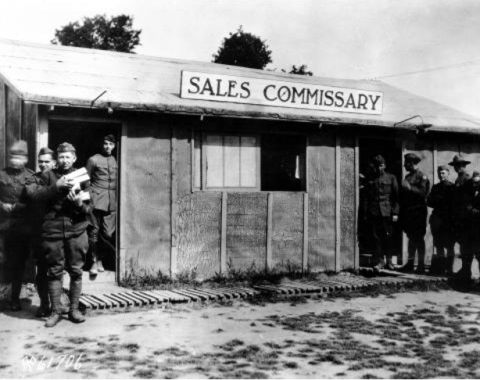
After the war, the benefit continued to grow. In 1867, U.S. Army enlisted personnel received the same at-cost purchasing privileges that officers had enjoyed for years. In the early days, almost any Army post warehouse could become a sales commissary, whether it was in a large city or on the frontier. Commissaries helped service members make their pay go farther while allowing the military to care for its own.
The first overseas commissaries opened in the Philippines and China in 1899 and 1900. Stores in the Caribbean and Panama soon followed. The U.S. Navy and Marine Corps opened their first commissaries in 1909 and 1910.
During World War I, rolling sales stores took canned goods, tobacco and other items to troops near the front lines in France. In the years that followed, commissaries began to change from small counter-service stores into stores more like civilian grocery markets. By the 1930s, some commissaries were experimenting with self-service shopping, home delivery and other conveniences.
Commissaries expanded rapidly during World War II, growing to more than 1,000 locations around the world. The stores provided groceries at cost to service members and their families, helping support morale and economic security during wartime.
After the war, each military service operated its own commissary system. The Army, Navy and Air Force had different procedures, systems and organizations. The 1950s and 1960s brought improvements that shoppers would recognize today, including better lighting, stock rotation, conveyor belts, accounting systems and home delivery programs. Some stores also offered phone-order drive-ups, small auxiliary stores and volunteer nurseries.
Commissaries continued supporting U.S. personnel overseas. The first American military commissary in Saigon opened in 1959, and the U.S. Army later took over commissary operations in Vietnam. Those stores remained open until the fall of Saigon in 1975.
Technology also changed the way commissaries operated. During the 1960s, 1970s and 1980s, stores began accepting coupons, introduced closed-circuit television systems and adopted the Universal Product Code and electronic scanning. Before scanners, clerks had to price every item by hand using stampers or price guns. By the late 1980s, nearly all commissaries had scanning equipment and computerized inventory systems.
With each service running its own system, there were still differences in procedures and operations. In 1989, Congress directed the Department of Defense to study the separate military commissary systems. The resulting Jones Commission report recommended bringing the systems together to improve customer service and save money. That recommendation led to the creation of DeCA. When the agency assumed control of military commissaries in 1991, it brought the Army, Navy, Marine Corps and Air Force commissary systems under one organization.
Over the past 35 years, DeCA has continued to modernize its operations and expand customer options. Today’s commissaries use computerized inventory systems, self-checkout lanes, security technology and online ordering through Commissary CLICK2GO®. At participating locations, customers can order groceries online and pick them up curbside.
DeCA also offers store-brand products, including HomeBase, Freedom’s Choice, TopCare, Full Circle Market and Tippy Toes. The list of eligible shoppers has grown as well and includes active-duty service members, retirees, military families, certain Reserve and National Guard members, Purple Heart recipients, Medal of Honor recipients, eligible disabled veterans and other authorized patrons.
-DECA-
About DeCA: The Defense Commissary Agency operates a worldwide chain of commissaries providing groceries to military personnel, retirees, disabled veterans and other authorized patrons and their families in a safe and secure shopping environment. Commissaries provide a military benefit, saving authorized patrons thousands of dollars annually on their purchases compared to similar products at commercial retailers. The discounted prices include a 5-percent surcharge, which supports the costs of building, modernizing and sustaining commissary facilities. A core military family support element and valued part of military pay and benefits, commissaries contribute to family readiness, enhance the quality of life for America’s military services and their families, and help recruit and retain the best and brightest men and women to serve their country.